

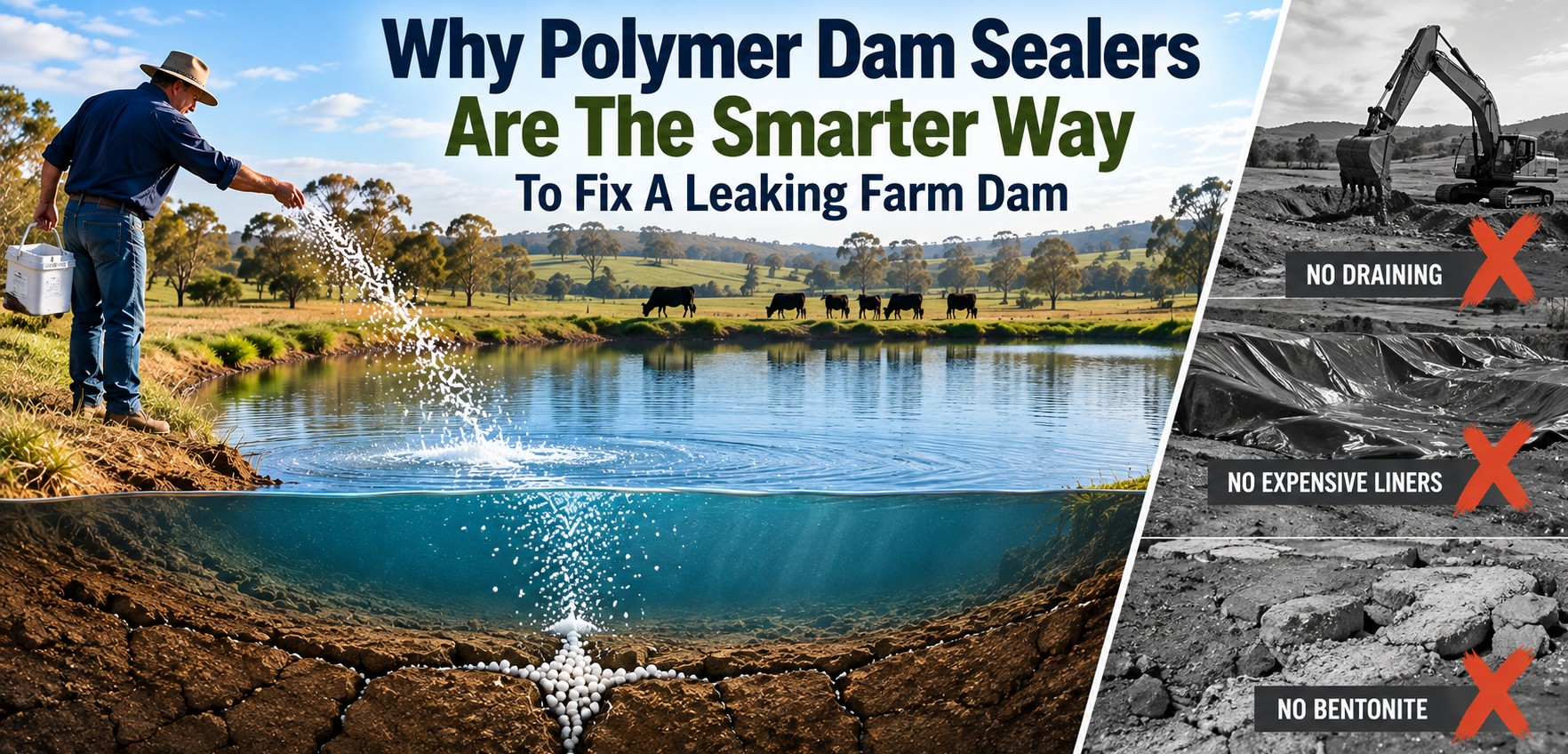
When a farm dam starts losing water, the first thought is often that fixing it will mean draining the dam, bringing in machinery or undertaking major earthworks. But for many leaking earth dams, there is a much simpler approach. Water$ave Dam Sealers use polymer technology to target leaks from within the soil while the dam still contains water. Instead of rebuilding, lining or excavating the dam, Water$ave is applied directly to the water surface & uses the movement of leaking water to help carry the polymer towards the problem. For Australian farmers & rural landholders looking to protect valuable stored water, this provides a practical DIY alternative to traditional dam sealing methods.
Start with Polymer Before Considering Major Dam Repairs
If an earth dam is structurally sound but losing water through cracks, porous soil or other leak pathways, completely rebuilding the dam can be an unnecessarily large response to the problem. Water$ave Dam Sealers are designed specifically for this situation. The dry polymer crystals are spread directly across the water surface in the area of the suspected leak. They sink through the water & are drawn towards active leak pathways. Once within cracks, voids & porous areas, the polymer absorbs water & swells to create a flexible internal plug. This gives Water$ave several important advantages for farmers:
- No draining the dam
- No digging or excavation
- No heavy machinery
- DIY application
- Targets active leak pathways
- Safe for livestock, crops & irrigation when used as directed
- Typical results within 7–10 days
Why Draining a Dam to Fix a Leak Doesn't Always Make Sense
Draining thousands of litres of stored water simply to access a leak goes against what is trying to be achieved, retaining water. For farmers relying on dams for livestock or irrigation, losing the existing water supply can also create another problem. Alternative water may need to be sourced while repairs take place & once the work is finished, you're dependent on rainfall to refill the dam.
Water$ave Dam Sealers turn this traditional approach around. The dam's existing water isn't an obstacle to treatment; it is part of how the product works. Water movement towards the leak assists in carrying the polymer into the leaking areas. That means a full or partially full dam can be treated without deliberately sacrificing the water already in storage.
Polymer vs Bentonite: A Very Different Approach
Bentonite is a swelling clay that has traditionally been used in dam construction & sealing. For an existing leaking dam, however, using bentonite can involve considerably more material handling & site work. Depending on how it is applied, the dam may need to be lowered or drained so the material can be incorporated into the soil & compacted. There is also the challenge of getting the material to the actual leak. Simply adding material to a dam doesn't necessarily mean it will reach the cracks or voids through which water is escaping.
Water$ave polymer technology is designed specifically to move towards active leak pathways. Instead of covering or rebuilding large areas in the hope of addressing the problem, the polymer is applied to the water & uses the movement of the leak to help reach the areas requiring treatment. For an existing leaking farm dam, that difference can mean significantly less disruption & less cost.
Polymer vs Plastic Dam Liners
Plastic & synthetic liners attempt to solve leakage by creating a physical barrier between the water & the underlying soil. For an existing earth dam, installing that barrier can mean a major change to the dam itself. The water generally needs to be removed, the dam surface prepared & the liner installed across the storage area. Rocks, roots & uneven surfaces can complicate installation, while damage or punctures can create future maintenance problems.
Water$ave Dam Sealers take the opposite approach. There is no liner to install. The polymer works within the soil rather than covering it. This allows the existing earth dam to continue functioning as an earth dam while the polymer targets the pathways responsible for water loss. Water$ave should not be applied to a dam that already has a plastic liner, as the liner prevents the polymer from reaching the soil where it needs to work.
Polymer vs Excavation & Rebuilding
Excavating a leaking dam can quickly turn a water-loss problem into a major project. Machinery needs access to the site. Water may need to be removed. Soil must be excavated, replaced & compacted. Contractors, machinery hire, fuel, materials & labour all contribute to the final cost. Then there is the disruption to the property itself. For a structurally sound dam with a leak, Water$ave Dam Sealers provide an opportunity to address the water-loss problem before considering that level of intervention. There is no need to excavate the base or wall during normal Water$ave application. The polymer is simply applied from the water surface & allowed to travel towards the leak. For many rural properties, that's a much more manageable DIY job.
Water$ave Dam Sealers Don’t Just Cover the Problem
One of the key differences between Water$ave Dam Sealers & barrier-based solutions is where the sealing action occurs. Water$ave doesn't simply place another layer over the dam. The polymer is drawn into cracks, voids & porous areas by the movement of escaping water. It then swells within those pathways to form a flexible internal plug. This is particularly useful because the precise underwater entry point of a leak can be difficult to locate. You might see a wet patch outside the dam wall without knowing exactly where the water entered the soil. Water can travel through the dam before appearing somewhere completely different. Water$ave uses that movement rather than requiring you to excavate the dam in search of the exact leak.
Water$ave Plug for Larger Leaks
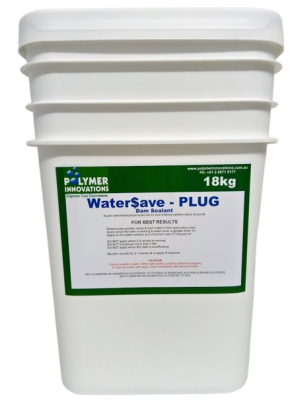
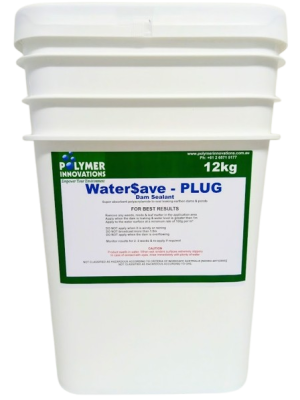
Different leaks require different polymer particle sizes. Water$ave Plug is designed for larger & faster leaks. It is generally suited to coarse soils, base leaks, larger cracks & voids or situations where water is visibly flowing outside the dam. A useful guideline is the rate of water loss. If the dam is losing more than approximately 150 mm per week, Water$ave Plug is generally the first product to consider.
Water$ave Seep for Slower Water Loss
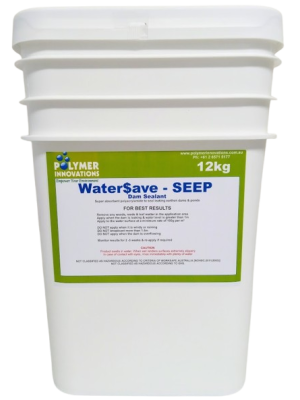
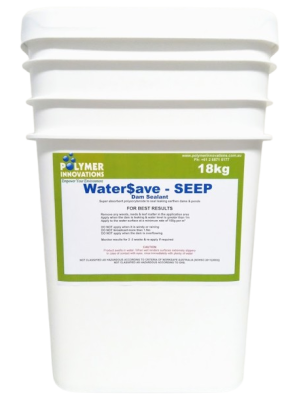
Not every leaking dam has an obvious flowing leak. Sometimes the water level simply falls faster than expected, or damp ground & unusually green vegetation begin appearing below the dam wall. Water$ave Seep is designed for these slower leaks. It is suited to fine or sandy soils, wall seepage & water loss of less than approximately 150 mm per week, particularly where there are wet areas outside the dam without visible flowing water.
Less Equipment. Less Disruption. A Simpler DIY Repair.
For a farmer, the cost of a dam repair isn't limited to the material used. There's also machinery, labour, transport, contractors, alternative water supplies & the time taken away from other work on the property. Water$ave Dam Sealers simplify the process. For many dams, application can be completed in under an hour. Product can be applied by hand from the bank, with a boat used where necessary to safely reach areas further than approximately two metres from shore. Once applied, the dam remains in service while the polymer begins working. There is no lengthy construction project & no waiting for the dam to refill before you can use it again.
Keep the Dam You've Already Got
If your existing dam is otherwise sound, why rebuild it simply because water has found a pathway through the soil? That's one of the biggest benefits of polymer dam sealing. Water$ave Dam Sealers work within the existing dam rather than replacing it. For working farms, hobby farms, livestock properties & rural blocks, this can make repairing a leaking dam significantly easier to manage. Water$ave Dam Sealers have been used in Australian conditions for more than 20 years. They are non-toxic, safe for livestock, crops & irrigation when used as directed.
Before You Drain, Dig or Line Your Dam, Consider Polymer
A leaking dam doesn't automatically mean you need an excavator, a new liner or large quantities of traditional sealing material. If the dam is structurally sound, the first step should be understanding the leak. Measure how quickly the water level is dropping. Look for wet areas or flowing water outside the dam. Consider whether the soil is fine, sandy, coarse or rocky. These clues can help determine whether Water$ave Plug or Water$ave Seep is the appropriate solution.
For many farmers & rural landholders, polymer provides exactly what they need from a dam repair: a simple way to target the leak without draining the dam, losing valuable stored water or undertaking unnecessary earthworks. If your dam is leaking, Polymer Innovations can help assess your situation & determine which Water$ave Dam Sealer is best suited to the leak.
Before you drain it, dig it or line it, try sealing it with Water$ave Dam Sealers.

Comments