

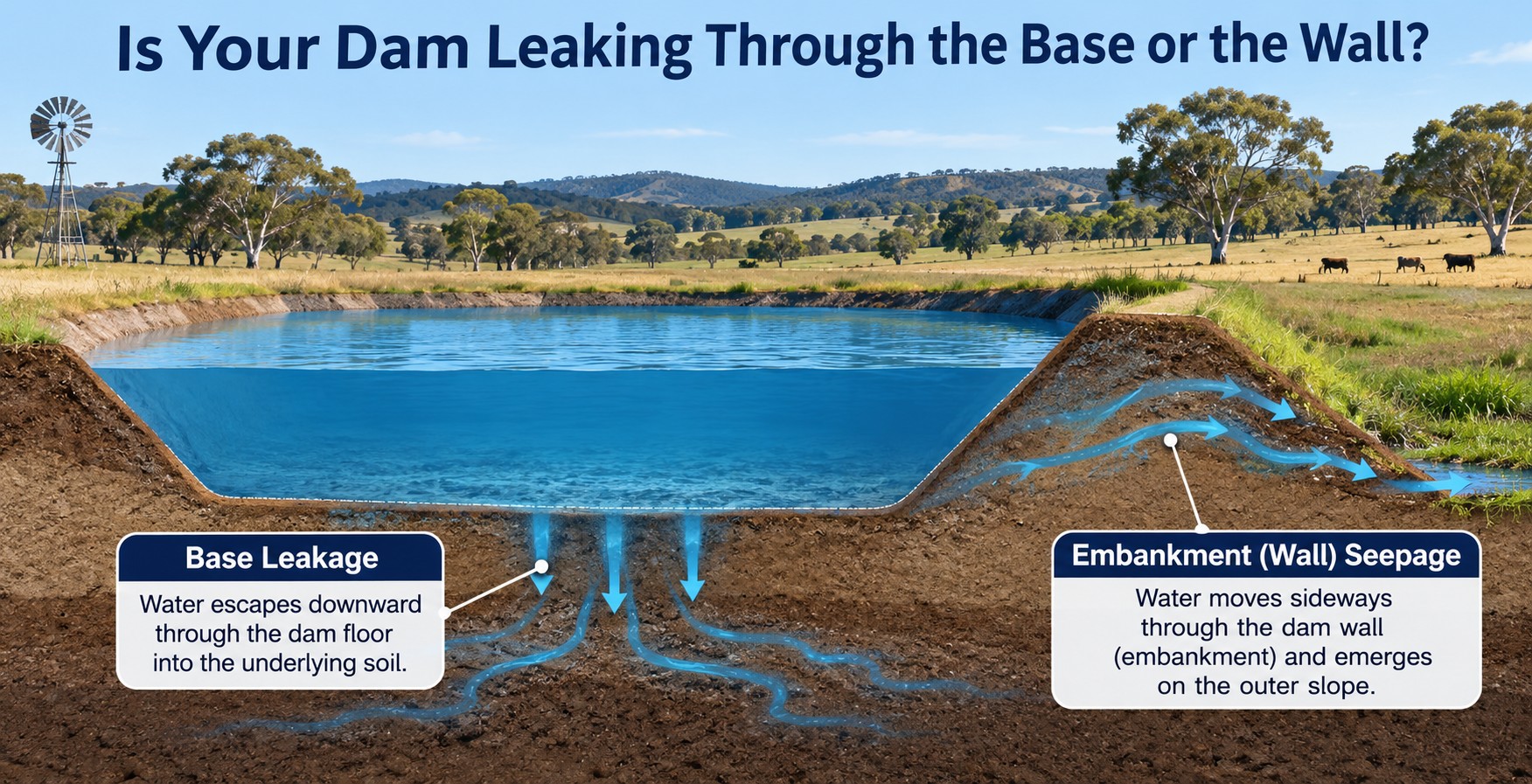
A leaking farm dam can lose thousands of litres of valuable water before the source of the problem becomes obvious. For Australian farmers & rural property owners, unexplained water loss can affect livestock supplies, irrigation availability & the overall reliability of stored water, particularly during extended dry periods. Identifying that your dam is leaking is only part of the problem; understanding whether the water is escaping through the dam base or the dam wall can help determine the most suitable repair method.
Earthen dams can develop leaks for several reasons, including porous soil, cracks, poorly compacted areas & hidden pathways beneath the waterline. Some leaks occur through the dam base, while others develop within the embankment or dam wall. The signs are not always obvious, making it important to understand what to look for before attempting repairs.
Why Does the Location of a Dam Leak Matter?
Not all dam leaks behave in the same way. Water escaping through the base of a dam may follow different pathways from water seeping through the wall or embankment. The location of the leak, the type of soil & the rate of water loss can all influence how the problem should be treated. For example, a dam built on coarse soil may allow water to escape through larger gaps or poorly sealed areas beneath the water. A dam constructed with finer soils may instead experience slower seepage through the wall or porous sections of the embankment. Understanding these differences can help property owners identify the likely cause of water loss.
Signs Your Dam May Be Leaking Through the Base
Leaks through the dam base can be particularly difficult to identify because the affected areas are hidden beneath the water. Unlike a visible leak through a dam wall, water escaping through the floor may travel into underlying soil or rock without creating an obvious wet patch outside the dam. Some common indicators of a possible base leak include:
- Water levels falling rapidly without an obvious external leak.
- Water loss continuing during periods of little or no water use.
- Dams constructed over coarse, rocky or highly permeable ground.
- Water levels continuing to fall even after rainfall has replenished the dam.
In some cases, the dam may appear structurally sound from the surface, making the leak difficult to locate without further investigation.
Signs Your Dam May Be Leaking Through the Wall
Dam-wall leaks can sometimes be easier to identify because escaping water may produce visible signs outside the embankment. A dam wall is designed to retain water, but cracks, poorly compacted soil or porous sections can allow water to move through the embankment. Common warning signs include damp patches, persistently wet ground or unusually green vegetation below the dam wall. You may also notice seepage appearing around the base of the embankment, even when there has been little recent rainfall.
In some situations, water may be visibly flowing from the outside of the wall. This can indicate a more substantial leak requiring prompt investigation. However, wet ground near a dam does not automatically confirm leakage. Rainfall, surface drainage & groundwater conditions can produce similar symptoms. The important distinction is whether the moisture is associated with water escaping from the dam.
How Much Water Is Your Dam Losing?
One of the most useful ways to assess a suspected dam leak is to monitor how quickly the water level falls. While evaporation naturally causes some water loss, unusually rapid or persistent drops may indicate leakage. A simple way to begin is by installing a fixed measuring point or marking the water level against a stable reference. Record the water level at the same time each day over approximately one week. Take note of rainfall, pumping, irrigation use & livestock consumption, as these factors can influence the results. If the water level continues to fall significantly beyond what can reasonably be explained by evaporation & usage, further investigation may be needed.
Does Soil Type Affect Where a Dam Leaks?
Soil composition plays a major role in how well an earthen dam retains water. Different soils contain different particle sizes, pore spaces & drainage characteristics, all of which can influence how water moves through the dam.
· Clay-rich soils are often used in dam construction because properly compacted clay can provide relatively low permeability. However, cracking, poor compaction or structural changes may still create leakage pathways.
· Sandy soils generally contain larger pore spaces than clay, allowing water to move through more readily. Depending on the dam's construction, this may contribute to gradual seepage through the wall or surrounding soil.
· Coarse or rocky soils can contain larger gaps & voids, potentially allowing faster water movement through the dam base or other affected areas.
Understanding the soil type can therefore provide useful clues about the likely cause of leakage. However, soil type alone does not confirm whether the leak is in the base or wall. The rate of water loss & visible site conditions should also be considered.
How To Fix The Leak?
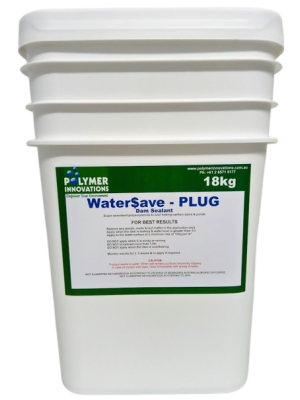
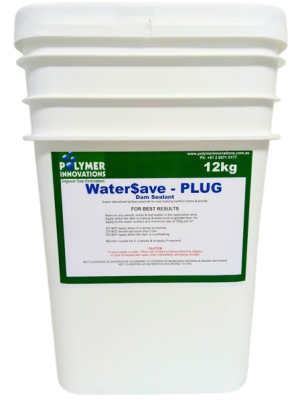
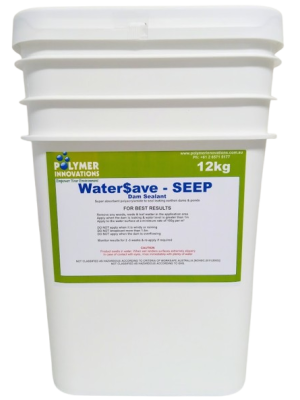
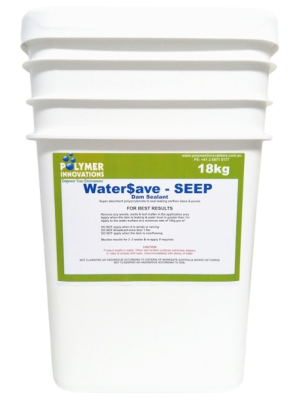
Repairing a leaking earthen dam doesn't always require draining the water, excavating the affected area or installing a liner. Water$ave Dam Sealers provide a practical DIY solution designed to seal leaks from within the soil, helping property owners protect their valuable water supplies without major earthworks. Polymer Innovations offers two specialised polymer dam sealers designed for different leakage conditions.
|
· Faster water loss, generally over 150 mm per week |
|
· Dam base leaks |
|
· Coarse or rocky soil |
|
· Larger cracks & leakage pathways |
|
· Visible water flow outside the dam wall |
|
· Slower water loss, generally under 150 mm per week |
|
· Dam wall seepage |
|
· Fine or sandy soil |
|
· Smaller pores & gradual seepage |
|
· Wet areas outside the wall without visible flow |
Both products use super absorbent polymer technology to help seal leaks from within the soil. The main difference is the type & severity of leakage they are designed to address. Selecting the appropriate product helps ensure the treatment is suited to the dam's conditions.
How Do Water$ave Dam Sealers Work?
Traditional dam repairs may involve draining the water, excavating soil, compacting sealing materials or installing a liner, Water$ave Dam Sealers work differently. Water$ave is dry polymer crystals that are applied directly to the water surface over the suspected leakage area. Once applied, the crystals sink through the water. Where water is escaping through cracks, voids or porous soil, the movement of water helps draw the polymer towards those pathways. As the crystals absorb water, they swell & help form a flexible seal within the soil structure. This process allows leaks to be treated while water remains in the dam. For many earthen dams, it eliminates the need for draining, digging or heavy machinery during application.
Water$ave Dam Sealers are designed for straightforward DIY application, making them particularly useful for farmers, hobby farmers & rural property owners seeking a less disruptive approach to dam repairs. Results are typically observed within approximately 7–10 days, although performance depends on the type of leak, soil conditions & application.
Can You Seal a Dam Leak Without Knowing the Exact Location?
Identifying the precise location of an underwater leak can be difficult. In many cases, there may be no visible crack or obvious point where water is escaping. One advantage of Water$ave Dam Sealers is that the movement of escaping water helps carry the crystals towards active leakage pathways. This means property owners do not necessarily need to expose the leak through excavation before treatment. However, identifying the most likely leakage area remains important. For example, a suspected wall leak should generally be treated near the affected wall area, while a suspected base leak may require treatment across the relevant section of the dam floor. Accurate product selection, appropriate coverage & correct application all contribute to the likelihood of a successful result. Having troubling identifying the leak? Polymer Innovations’ friendly Dam Experts can help you with a FREE dam assessment.
Stop Losing Water & Choose the Right Dam Sealer
If your farm dam is losing water, identifying whether the leak is occurring through the base or wall is an important first step towards finding the right solution. Rapid water loss, coarse or rocky soils & suspected base leaks may indicate that Water$ave Plug is the more appropriate option; Slower seepage, wet patches outside the embankment & fine or sandy soil conditions may indicate that Water$ave Seep is better suited. Both Water$ave Dam Sealers are designed to seal leaks from within the soil without draining the dam or using heavy machinery for application. For Australian farmers & rural property owners, this provides a practical way to address water loss while protecting valuable stored water.
Not Sure Which Water$ave Dam Sealer You Need?
Polymer Innovations can help you assess your dam's leakage conditions & select the most suitable product. Our Dam Experts can discuss your water-loss rate, soil type & suspected leak location to help determine whether Water$ave Plug or Water$ave Seep is appropriate.
Contact Us for a free dam assessment over the phone or submit your dam details for assistance.

Comments